
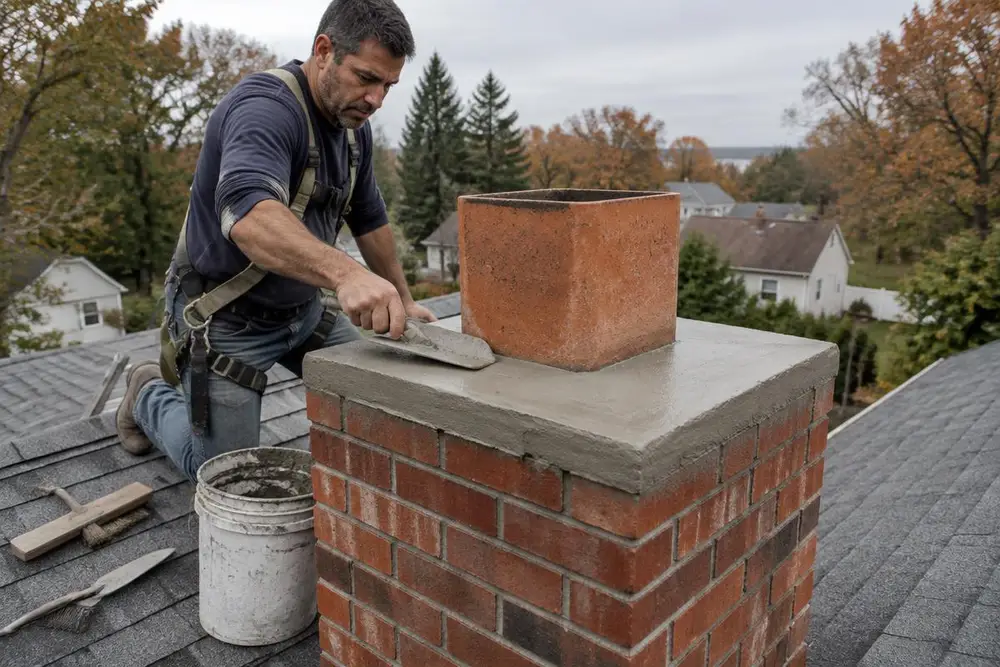
Homeowners often use "crown" and "cap" interchangeably, and it's easy to see why — both are at the very top of the chimney, and both are there to keep water out. But they're different parts, made of different materials, that fail in different ways. Knowing which is which makes it much easier to understand an inspection report or an estimate.
The chimney crown
The crown is the masonry slab — usually concrete or a mortar mix — that covers the top of a brick chimney around the flue tiles. Its job is to seal the top of the masonry and shed water away from the brick.
A well-built crown is thick enough to resist cracking, slopes away from the flue, and overhangs the brick on all sides with a drip edge so water falls clear of the chimney instead of running down its face. There should also be a small gap or flexible seal between the crown and the flue tile, since the two expand at different rates when heated.
In practice, many crowns are thin layers of mortar troweled flat over the top course of brick, with no overhang. In New York's freeze-thaw winters, those crowns crack. Water then soaks into the masonry below, which leads to spalling brick, washed-out mortar and leaks inside.
The chimney cap
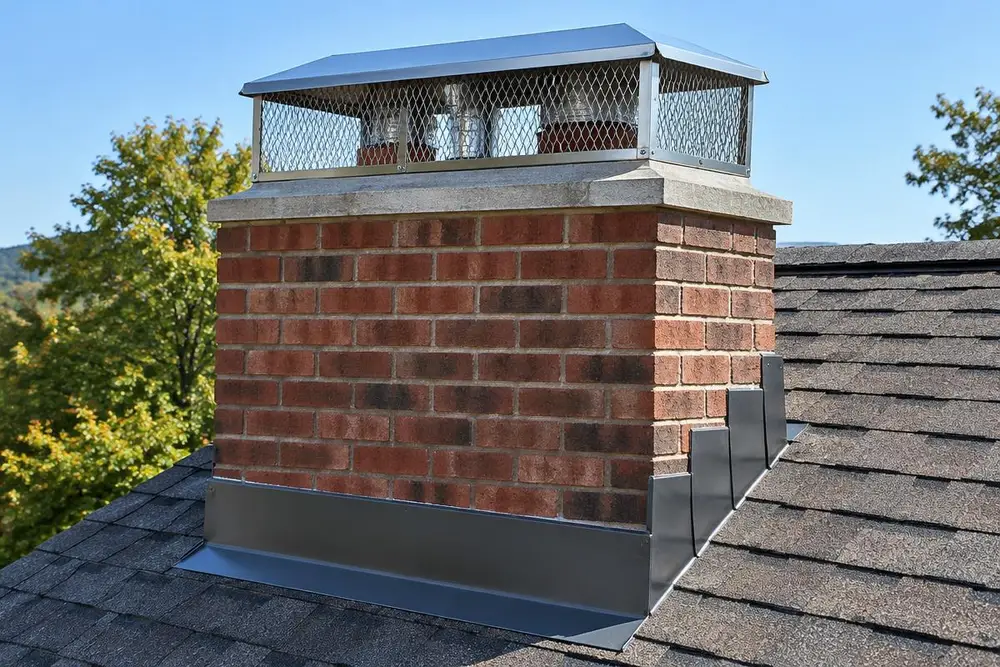
The cap is the metal cover that sits over the flue opening — usually stainless steel or copper, with a hood on top and mesh around the sides. It does several jobs:
- Keeps rain and snow from falling straight down the flue
- Keeps out leaves and debris
- Keeps out birds, squirrels and raccoons
- Helps stop sparks and embers from landing on the roof
- Can reduce wind-driven downdrafts in some situations
Single-flue caps attach to one flue tile. If your chimney has more than one flue — common when a fireplace and a boiler share a chimney — a multi-flue cap covers the whole crown. A multi-flue cap also gives the crown some protection from direct rain.
How they work together
Think of the crown as the roof of the chimney and the cap as the cover on the pipe. The crown protects the masonry; the cap protects the flue. A chimney with a great cap and a cracked crown will still let water into the brick. A chimney with a perfect crown and no cap will still let rain and animals into the flue.
Signs your crown needs attention
- Visible cracks or crumbling on top of the chimney
- Pieces of concrete on the roof
- Spalling brick near the top courses
- Water in the firebox or stains on the chimney breast
Small hairline cracks can often be sealed with a flexible crown coating. Wide cracks, missing pieces or a crown with no overhang usually mean replacement. See chimney crown repair and replacement.
Signs your cap needs attention
- There isn't one
- Rust, holes or a bent hood
- Torn or clogged mesh
- Animals or nesting material in the chimney
- Rain dripping into the fireplace
Near the water — Rockaway, Long Beach, the South Shore canals, the North Shore harbors and the East End — salt air rusts cheap galvanized caps quickly, so stainless steel or copper holds up better. See chimney cap installation.
Repair them together when it makes sense
Because a cap is usually anchored to the flue tile or the crown, replacing a crown is a natural time to install or reset the cap. Doing both at once means one trip to the roof, and you know the top of the chimney is sealed as a system.
What about top-sealing dampers?
A top-sealing damper is a damper mounted at the top of the flue that's opened and closed by a cable from the firebox. Many include a cap-style hood. They're a good option when the throat damper is rusted out, and they seal much tighter than a traditional damper. See damper repair.
If you're not sure what's on top of your chimney or what condition it's in, a chimney inspection will tell you — with photos of both the crown and the cap.