Plenty of homeowners in Queens and on Long Island never use their fireplace — but their chimney still runs every day from October to April. That's because the boiler or furnace vents through it. And in this region, a lot of those boilers still burn oil.
Oil heat is reliable and common here, but it leaves something behind in the chimney every season. That's why the heating flue needs its own regular cleaning, separate from your burner tune-up.
What oil heat leaves in the chimney
Even a well-tuned oil burner produces some soot. Over a heating season, soot and scale (flaky deposits that form on flue walls) build up inside the flue and fall to the bottom of the chimney. If the burner is out of tune or has a puff-back — a small ignition explosion that blasts soot through the system — the buildup can be much heavier.
Left alone, that debris collects at the base of the flue below the point where the boiler connects. Over time it can partially block the connection, restricting how well exhaust leaves the house.
Why that matters
- A restricted flue can push exhaust, including carbon monoxide, back into the home.
- Soot and moisture together are corrosive to clay flue tiles and mortar.
- Heavy buildup can affect how efficiently the boiler runs.
- A blocked flue can cause the burner to shut down on a cold night.
Every home with fuel-burning appliances should have working carbon monoxide alarms. A flue cleaning isn't a substitute for them — it's one more layer of protection.
Burner service vs. chimney flue cleaning
Your oil company's annual service focuses on the boiler or furnace: the nozzle, filters, electrodes and combustion. Some technicians will vacuum the smoke pipe. But the chimney flue itself — the masonry or lined passage that runs up through the house — is a separate part of the system. Cleaning it means brushing the flue and emptying the debris from the clean-out at the base.
Scheduling the chimney cleaning around the same time as your burner service is the easiest way to remember both. See furnace and boiler flue cleaning.
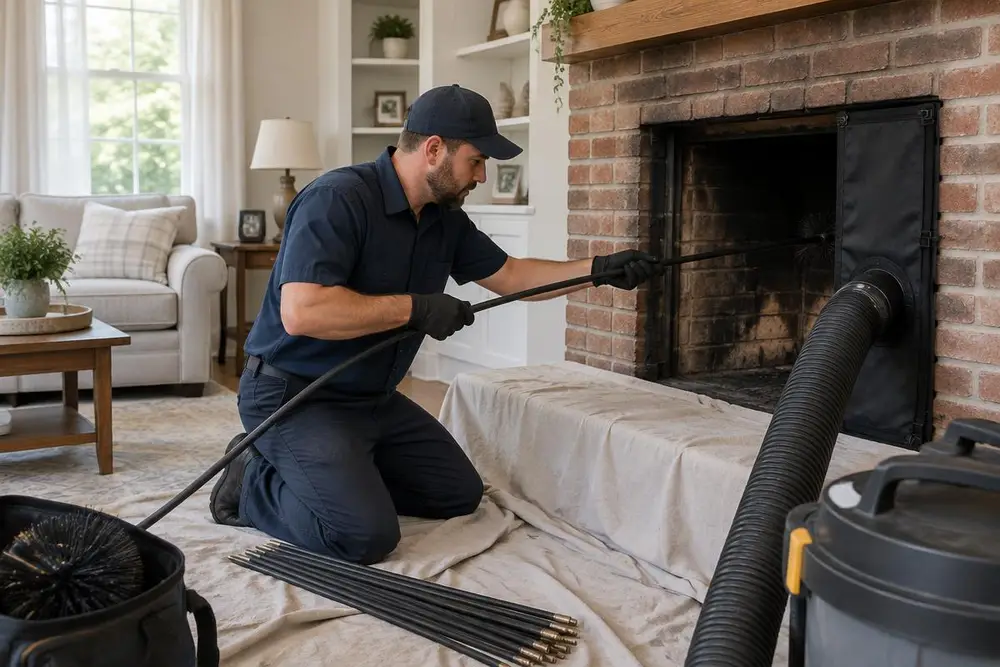
What we look for during a heating flue cleaning
- The amount of soot and scale at the base and in the flue
- Cracked or missing clay flue tiles
- Gaps in the joints between tiles
- Signs of condensation or staining
- The cap and crown on top of the chimney
Converting from oil to gas
Many Queens and Long Island homes have switched or are switching from oil to gas. That change affects the chimney. Modern gas appliances produce cooler, wetter exhaust that's more acidic than oil exhaust. In an old, oversized clay-tile flue, that exhaust can cool and condense on the way up, and the condensation attacks the tiles and mortar.
That's why a fuel conversion often calls for a stainless steel liner sized for the new appliance. The NFPA 211 standard also calls for a Level 2 inspection when the fuel type or appliance changes. See chimney relining and Level 2 chimney inspection.
After a puff-back
If your burner had a puff-back, soot may have been blown through the smoke pipe and into the chimney — and sometimes into the house. After the burner is repaired, have the chimney flue checked and cleaned too.
Shared chimneys
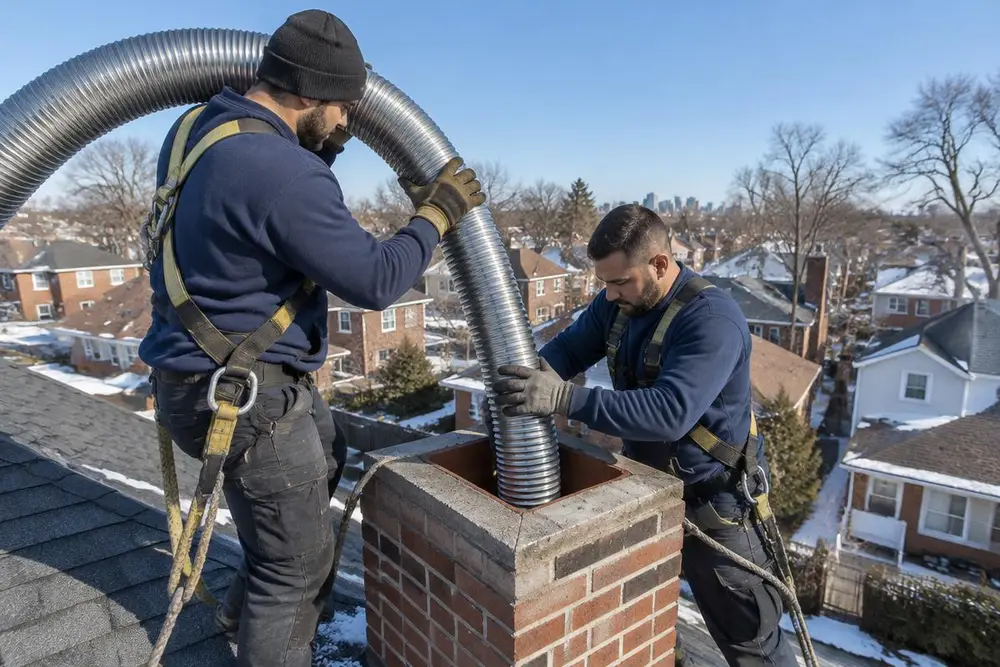
In many homes, the boiler and the fireplace share one chimney with two separate flues. Each needs attention: the heating flue for soot and scale, and the fireplace flue for creosote if you burn wood. A multi-flue cap protects both.
Our recommendation
- Clean the oil heating flue once a year.
- Have the chimney inspected annually, as NFPA 211 recommends.
- Get a Level 2 inspection before converting from oil to gas.
- Install a cap on every flue.
- Keep carbon monoxide alarms on every floor.
We clean heating flues across Nassau County, Suffolk County and Queens. Learn more about chimney cleaning and chimney liner installation.